
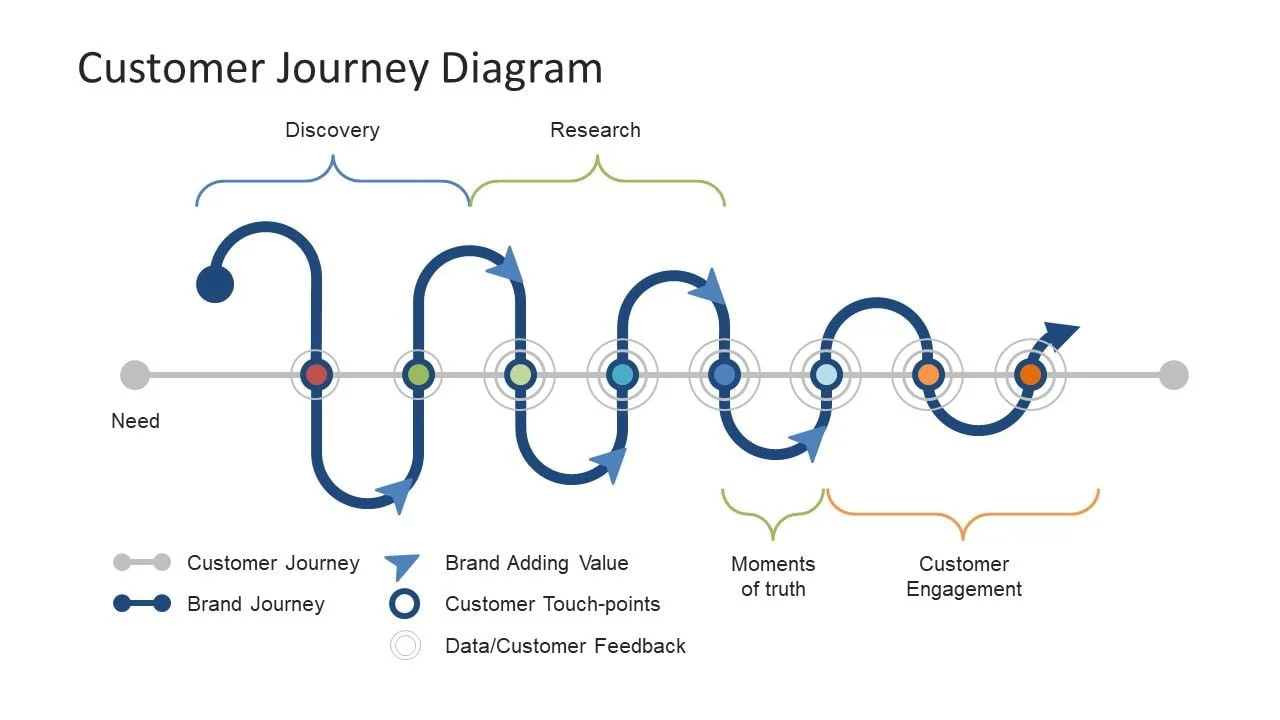
A CJM is written on behalf of the customer, usually starting with the problem they want to solve, and describes the customer's entire experience with the company in solving that problem. CJM ends with a completed transaction — a purchase or a signed act of completed work, shipped goods.
What tasks does CJM solve?
The main task of CJM is to identify subtle moments in the process of interaction with the client. Find out where we can lose a client, at what stages, why. And eliminates errors.
Five steps:
- CA assembly and issues that can be resolved with the product.
- Fixation of possible points of contact of the customer with the product on the way to solving the problem and channels of interaction.
- Descriptions of the customer's experience with the product at each touch point (it is also necessary to track at what point the customer abandons the order).
- Finding obstacles in the way of the customer to successfully solve the problem with the help of the company's product.
- Eliminate obstacles in the way of the client.
Five questions for creating a CA:
- Who are your customers?
- What do your customers want?
- Why do they want to get it?
- Where will customers look for information about the product and the product itself?
- When might the customer need the product itself?
- Points of contact in CJM
What should be described in each CA portrait:
- gender and age;
- marital status, whether there are children;
- place of residence and occupation;
- income level in numbers;
- social status;
- places where a person spends his free time, what he is interested in;
- what happens if the customer does not solve their problems with your product;
- how a person makes a purchase decision or consults with someone;
- which prevents him from solving the problem;
- pains and fears;
- denial;
- what the customer might like about your competitors.
Touch points in CJM are places where a customer can encounter our product. These can be online platforms, for example, a site, its specific pages, for example, a product or service page, and offline platforms, for example, a company office. Also touchpoints include interaction with advertising, agents and social networks.
Touchpoints are important for CJM compilation because they are the specific platforms where the customer interacts with our product. And depending on whether the touchpoints meet the customer's expectations, the customer may leave or stay. We capture these sites and can measure the conversion for each of them.
Search for obstacles on the way of the client and their elimination:
- advertisement is not available;
- the customer never clicks on the ad, preferring natural search;
- the client was attracted by the second advertisement because the price was indicated there, and this is important to the client / the competitor's UTP looked more attractive, etc.
- the customer does not trust our brand, as he has never heard / read about us
- negative reviews about the products presented on our website, etc.
Task Solution
- there are no ads in output - semantics are constantly updated, new requests are added / control of price and volume of traffic / control of traffic by requests.
- SEO - is there organic / traffic growth control / site visibility control in search engines.
- the client was attracted by the second advertisement because the price was indicated there, which is important to the client / the competitor's UTP looked more attractive, etc. - monitoring of declared competitors (as well as switching to competitors' social pages and analyzing their audience) / fixing the necessary UTP in a prominent place in advertising.
- the client does not trust our brand, because he has never heard of us / read negative reviews about the products presented on our website, etc. - launch of videos and banner ads (including on social networks) / branding.