
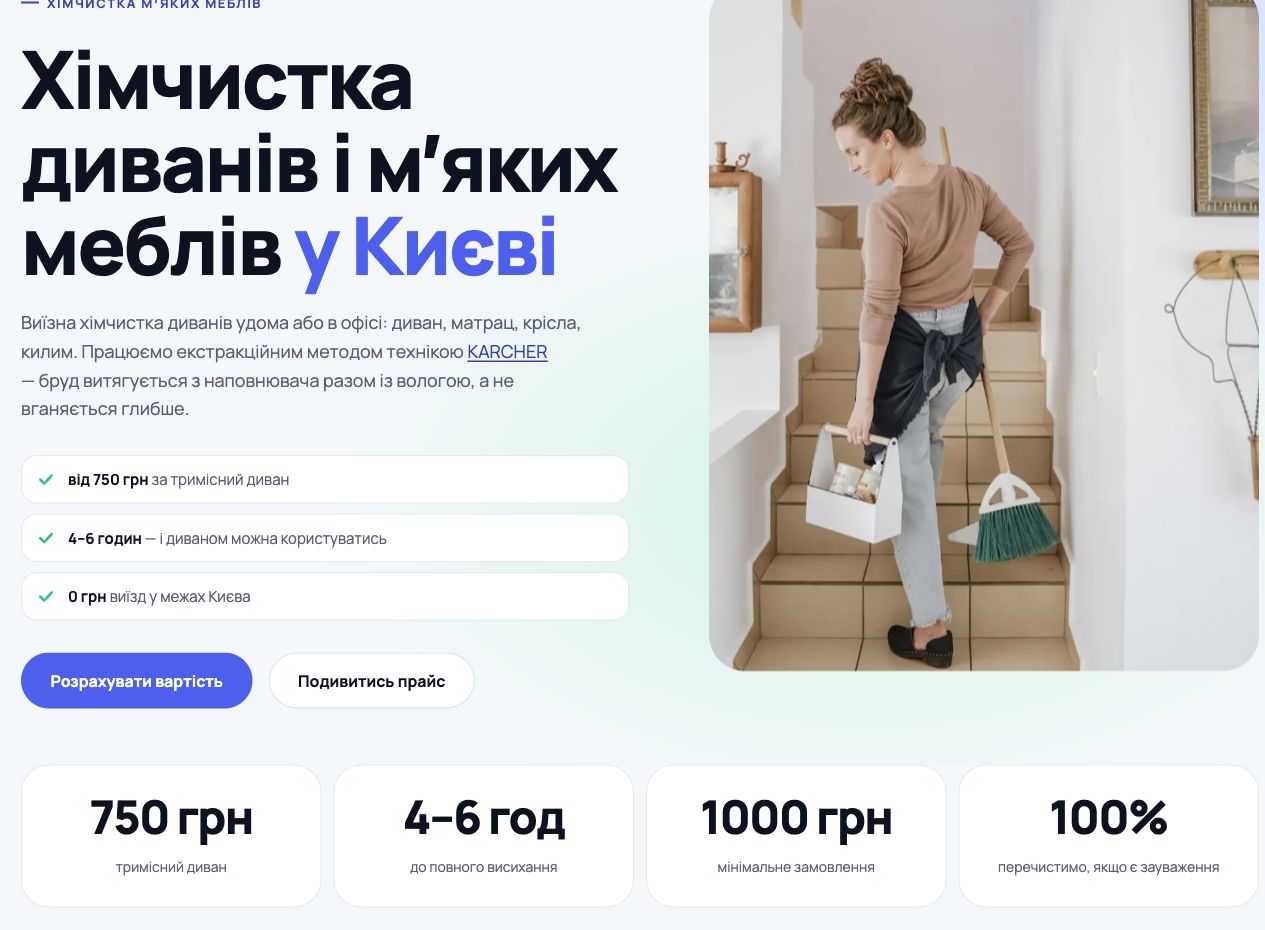
A customer says a competitor will clean their sofa for UAH 750. You charge UAH 1,000. Should you offer a discount? Kyiv’s A‑Cleaning does list a three-seater from UAH 750, but its minimum order is UAH 1,000. For someone with a single sofa, your price matches the competitor’s minimum. Before offering a discount, find out which terms the customer compared.
We looked at what someone searching for sofa cleaning in Kyiv would actually find. We priced three baskets using two companies’ price lists, then checked a third company’s ad against its website. The examples show when to reconsider a price, what to change on a service page and which idea is worth testing in an ad.
Which competitors belong in your comparison?
Describe one recent order in the customer’s own words. Someone in Kyiv wants a three-seater cleaned and dry enough to use that evening. A hotel operator needs twenty sofas cleaned overnight. They are in the same city, but their shortlists are different. Build a separate comparison for each buying situation.
| Group | How to identify them | What to compare |
|---|---|---|
| Direct competitors | Customers can buy the same outcome from either provider in the same city. Here the direct competitors are A‑Cleaning, Chystyi Kyt and ReinHaus. | Compare what is included, the total price, timing and terms. These providers belong in the same pricing table. |
| Other ways to get the job done | A customer can rent an upholstery cleaner and do some of the work themselves. | Include detergent, delivery and the customer’s time. Ask people who declined your service whether they considered renting the equipment. |
| Competitors for search visibility | A marketplace or directory appears for your search term and lets people choose among several providers. | Check what people can compare before calling, such as ratings, available dates, work samples and prices. Which of those details can they find on your site? |
One business can appear in several groups. For a contractor listed on a marketplace, enter the marketplace under “where found” and the terms against the contractor’s name. This avoids counting one provider twice. Two questions for an actual buyer will sharpen your shortlist. Who else did they consider? What finally decided it for them?
What to investigate from the first search to payment
Your sales rep has logged three lost orders as “too expensive.” One buyer genuinely had a smaller budget. The second saw a unit price and only learned about the minimum order on the phone. The third had already booked whoever replied first. Only the first conversation establishes a budget constraint. Here is what to record to tell them apart.
| Area | What to record | Decision it informs |
|---|---|---|
| Where buyers find the business | Record the query, whether the business appears in Maps, an ad or an organic result, and which page opens. | Identify a gap in visibility. A local search may need a Maps listing, while a price query might call for a price list. |
| Purchase terms | Match the product or scope first. Then record the total, minimum order, compulsory extras and promotional terms. | Find out which orders actually cost less elsewhere and whether your price needs to change. |
| Confidence in the result | Which concern does a work sample, an expert’s answer or a review resolve? Write down the buyer’s actual question. | Choose evidence to show before an enquiry. For a difficult stain, this might be a photo of a similar fabric after treatment. |
| Path to purchase | On a phone, follow the initial promise through to the form, basket or chat. Note when the final price becomes clear. | Remove an unnecessary step or show an important condition where the decision happens. |
| Why the sale was won or lost | Use your CRM to check what was discussed, which alternatives came up and whether the order was paid. Leave unknown reasons blank. | Choose the first change using documented lost sales and agree on how to measure it. |
1. The offer — what does the same order actually cost?
Use the same specification for each quote. Here it is a three-seater at an address in Kyiv, without extra treatments. Record the unit price, minimum order, call-out fee and possible extras. Save the source URL and the date. If the final price depends on a photo or an inspection, record that condition.
| Customer’s order | A‑Cleaning | Chystyi Kyt |
|---|---|---|
| One three-seater | From UAH 750 for the sofa. Minimum order UAH 1,000. | UAH 1,800 for the sofa, UAH 800 short of the UAH 2,600 minimum. |
| The same sofa and one armchair | From UAH 1,300 (750 + 550). This meets the call-out minimum. | UAH 2,345 (1,800 + 545), still UAH 255 below the minimum. |
| The sofa and two armchairs | From UAH 1,850 (750 + 2 × 550). | UAH 2,890 (1,800 + 2 × 545), above the minimum. |
We used the prices listed by A‑Cleaning and Chystyi Kyt on 23 November 2026, before discounts or job-specific extras. A‑Cleaning quotes starting prices and says it agrees the final amount before the visit. Chystyi Kyt suggests combining smaller items to meet its minimum. Ask the provider whether it would accept a smaller job for a top-up.
The listed armchair rates differ by just UAH 5. Yet the terms are substantially different for someone booking a sofa and an armchair in one visit. Look at your own order mix. If most customers book one item, display the minimum beside the first price. If bundles are common, price a familiar combination. For an online shop the equivalent is comparing the same product on its own and in the basket with delivery.
Worked example — comparing three companies
Add ReinHaus and imagine a buyer with all three tabs open. Which details can they find without contacting anyone? The comparison uses publicly posted terms as of 23 November 2026.
| Buyer’s question | A‑Cleaning | Chystyi Kyt | ReinHaus |
|---|---|---|---|
| What does a sofa clean cost? | Three-seater from UAH 750, minimum order UAH 1,000. | Three-seater UAH 1,800, minimum order UAH 2,600. | Sofas from UAH 900. This is a category starting price. |
| How do I get a price for my furniture? | Send an enquiry. The company says it confirms the amount before the visit. | Select items in the online calculator to see the total for the set. | Message the company on Viber or Telegram. It advertises a five-minute quote. |
| When can I use the furniture again? | The company indicates 4–6 hours. | 4–8 hours. The page explains how ventilation and the season affect drying. | The service description gives a range of 6–8 hours. |
All three providers give drying times. Where they differ is how people get a final quote. A calculator can suit a standard set of items. For unusual upholstery, sending a photo and talking to a specialist might be easier. Check your enquiries before investing in a calculator.
Ask your sales rep for a few recent conversations that ended without a booking. “My budget is UAH 800” and “But the website said 750” may both be filed as price objections. For the second, test a change without cutting the rate. Show the minimum beside the price and explain when the quote is confirmed. Then check whether fewer enquiries are lost over that discrepancy.
What reviews reveal about the decision
One review on the ReinHaus site describes a sofa clean after a move and mentions the technician arriving on time. Another describes stains and odour left by a dog. One buyer needs the visit to fit their day. The other wants to know whether a smell can be removed from their particular fabric. Ask what worried the customer most before booking.
The company selected those reviews for its own site. To see how typical the concerns are for your customers, take the last 20 consecutive enquiries, including lost sales. Record the trigger, the question asked before booking and the outcome. If odour keeps coming up, ask a technician for a comparable job and an explanation of when an inspection is necessary. You now have something specific to show on your service page.
2. Search — which pages help customers choose?
Compare results for a booking query, a price query and an informational question. Our Ukrainian examples translate as “book sofa cleaning Kyiv”, “sofa cleaning price Kyiv” and “how long does a sofa take to dry after cleaning?”. Record the URL and page type, city, device and date so you can reproduce the check.

A marketplace lets buyers compare several technicians at once. On your website they see one offer. Give them enough detail to decide, including the call-out cost, how the price is agreed and when the sofa can be used.
How to decide whether you need a new page
- Start with your own site. In Google Search Console’s Performance report, set the country and dates and add a “Queries containing” filter. For our example, use the Ukrainian stem “хімчистка диван”. Under Pages, find the URL receiving impressions. If it is a service page, add the details a buyer might be missing, such as rates for different sofa sizes or call-out terms.
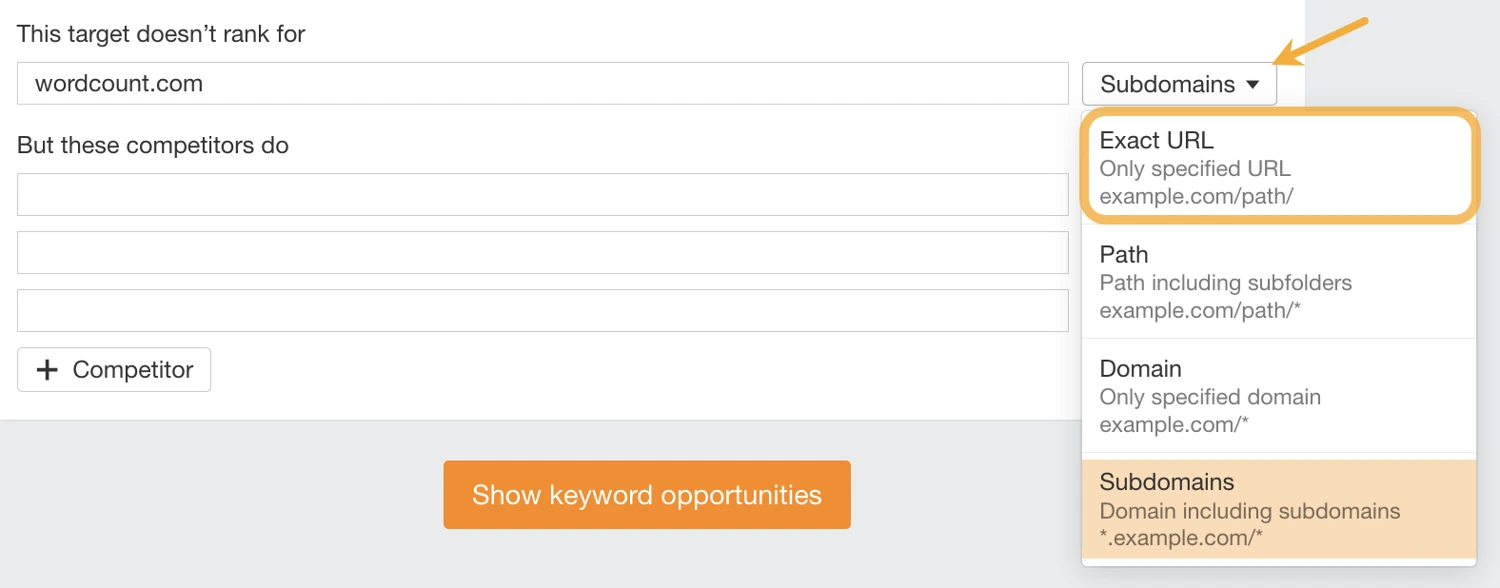
- Compare pages for the same service. In Ahrefs, open Competitive Analysis → Content Gap. Enter your service page and two or three competing pages using Exact URL. Select the country and examine their ranking terms. Check two or three queries from each promising group in Google. A question about call-out charges can be answered in your price list. A step-by-step fabric care guide deserves its own article.
- Define how you will measure the change. Save the page’s impressions and clicks from Search Console. Use GA4 or your CRM for organic enquiries where source and landing page are recorded. After the change, compare equal periods with the same filters. If clicks rise but enquiries stay flat, inspect the queries driving the gain. DIY cleaning questions may explain the increase. Check booking-related searches separately.
3. Advertising — what does the ad promise and where does it lead?
The ReinHaus ad shows a starting price and links to offers. The ReinHaus website says a 10% discount applies to the first order.
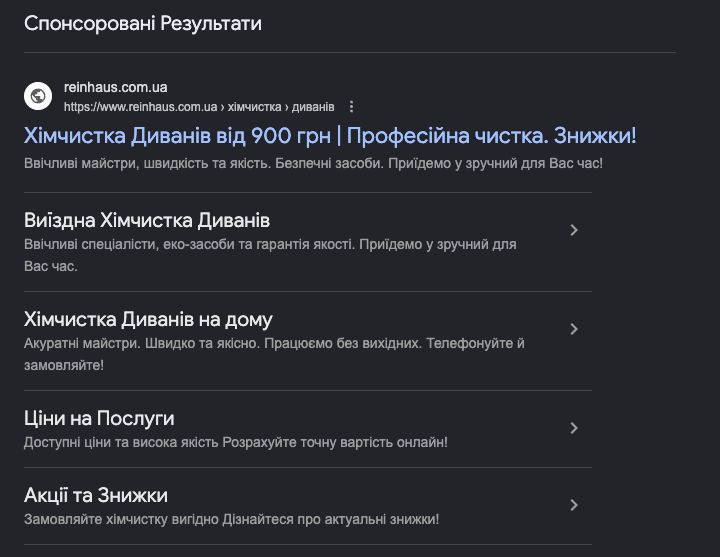
On the ReinHaus site, UAH 900 is a starting price for the sofa category. The ad does not specify a size, so it would be misleading to enter 900 in the three-seater row. There is another selling point worth recording. Buyers can message the company on Viber or Telegram for what it describes as a five-minute quote. The next step is clear. Public information cannot establish actual response times or how many chats become bookings.
Where else to investigate ads
- Google Ads Transparency Center. Search by domain or advertiser name and set the country and date range. Review several ads and record recurring services, prices and terms. If a domain is associated with multiple advertisers, verify the company name.
- Serpstat and Semrush. In Serpstat, open Keyword research → PPC research → Competitors, enter a query and choose the database. In Semrush, start with the domain in Advertising Research. Ads Copies lists ads the tool has found, and Pages lists known paid landing pages. Check coverage for your market. A single observation cannot reveal the campaign settings.
- Your Google Ads account. For an active campaign, open Auction Insights. Overlap rate is the share of your impressions where another advertiser also appeared. At 60%, the other advertiser appeared alongside you on 60 out of 100 impressions. Then inspect your own terms and conversions in the search terms report. This helps you pick an ad message to test on queries already bringing in customers.
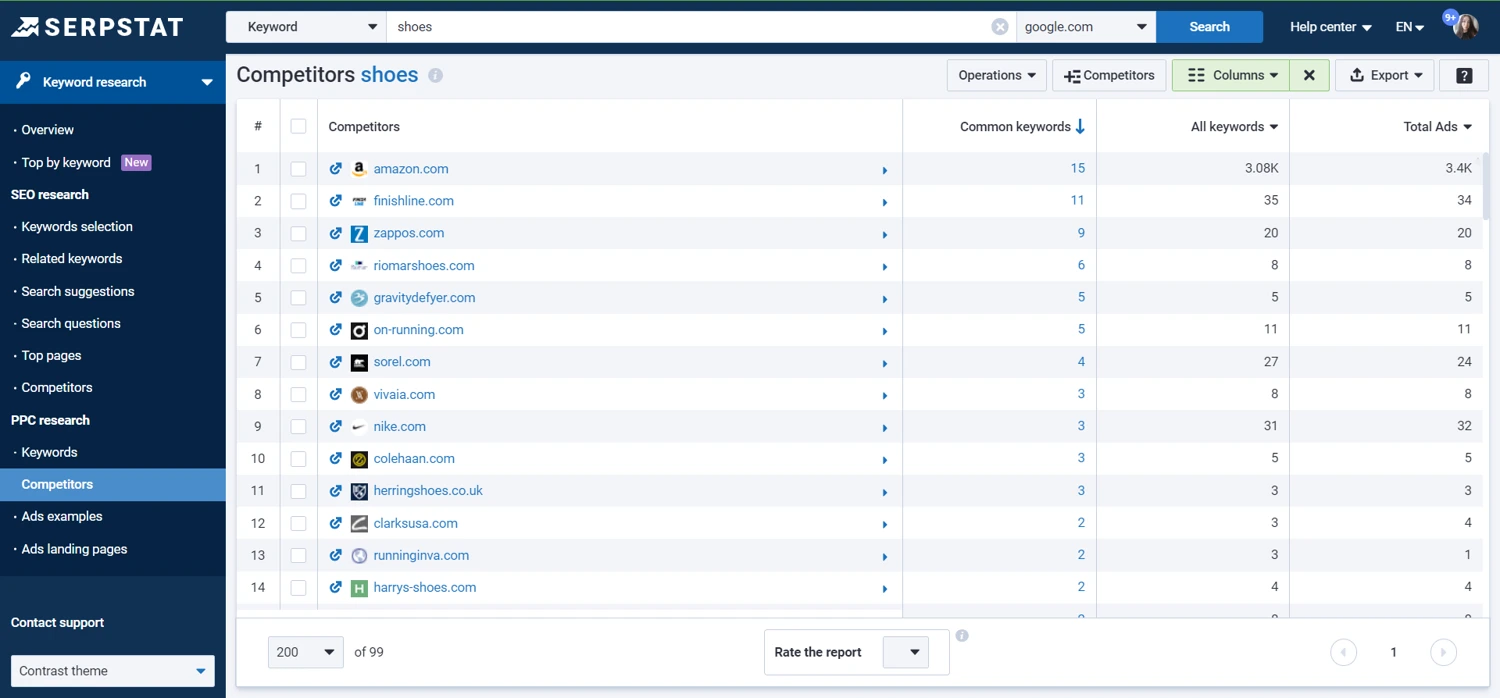
The tool found 15 shared terms for Amazon out of roughly 3,000 paid terms overall. For Finish Line it found 11 out of 35. A footwear retailer could learn from both, but the specialist shop offers a useful starting point. Check which categories its ads lead to. These counts describe the tool’s sample. They cannot tell you the budget, revenue or profitability.
How to test your own idea
Suppose people regularly ask for a firm price before the visit. If your technician can price a job from a photo, test “Send a photo for a quote”. Show where to send it and when to expect a reply. Keep the other test conditions comparable and record which enquiries become orders in your CRM.
For illustration, a UAH 100 lead with a 20% booking rate costs UAH 500 per booking. A UAH 150 lead with a 40% booking rate costs UAH 375 per booking. The second option saves UAH 125 in ad spend per confirmed order. Compare average order value, fulfilment costs and cancellation rates before deciding which is better for the business.
A competitor analysis worksheet for your business
For each finding, record the source, your own evidence and one proposed change. Where sales or analytics data are inconclusive, write down the question you still need to test.
| Observation | What to check internally | Change and measure |
|---|---|---|
| The price list shows a sofa rate and a separate minimum. | Do customers expect a lower total after reading the page? | Show the minimum beside the price. Track sales lost over unexpected totals. |
| Drying time appears in search questions. | Do customers ask before booking, and which page already receives impressions? | Answer on the service page. Track clicks and organic enquiries. |
| A competitor advertises a price and a discount. | Do buyers want a lower price or a firm quote before the visit? | Test photo quotes if the team can deliver them. Compare ad spend per confirmed booking. |
How to maintain the worksheet
In Google Sheets, use one row per company and buying scenario. The column headings below are tab-separated. Copy the line into cell A1 and enter your own company first so every observation has a point of comparison.
Company Customer’s order Listed price Minimum and extras How to get a final quote Source and date What we will test Metric
Return to the customer who found cleaning for UAH 750. Ask the rep to record whether the final total was acceptable and whether the sale went through. If the same gap between the advertised price and minimum keeps causing confusion, display the amounts together. Then compare price-related losses and confirmed bookings from the same source. That gives you evidence for deciding whether to change the rate itself.
For a closer look at paid search, iWeb offers Google Ads competitor analysis.