
A buyer can start choosing a supplier or product by talking to an AI assistant: describing a problem, comparing options and asking for a recommendation. For a business, this is another place to be visible. But a company mention does not automatically bring a visitor to its website, and a visit does not automatically become a customer.
This guide explains generative engine optimization (GEO), its relationship with SEO and the changes worth making to your website. We use actual iWeb pages as examples and provide a practical review process you can discuss with your team or agency.
What is generative engine optimization?
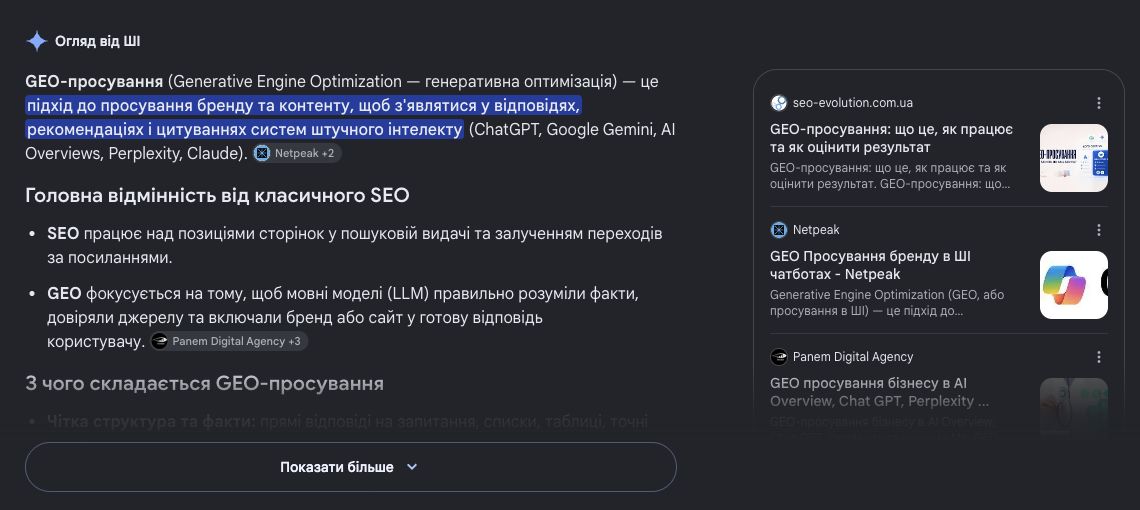
GEO is the work of improving a website’s and brand’s visibility in answers produced by generative search systems. It stands for Generative Engine Optimization. The aim is to make company information accessible, clear and substantive enough for a system to use when preparing an answer.
This concerns search experiences with AI-generated answers, such as Google AI Overviews, AI Mode, ChatGPT with web search, Perplexity and Copilot. Three outcomes need to be distinguished: the system mentions your company, it cites your website, or someone clicks that citation. These are different events and should be measured separately.
GEO vs SEO vs AEO: what is the difference?
These approaches overlap. It is more useful to compare the part of the search experience each examines than to treat them as mutually exclusive services.
| Approach | Main focus | Example task | What to check |
|---|---|---|---|
| SEO | Page visibility in search and relevant visits | Create a service page, resolve indexing issues and add relevant internal links | Impressions, clicks, queries, landing pages and enquiries |
| GEO | How a company and its content appear in generative answers | Review the sources used to compare suppliers and identify missing product information | Brand mentions, page citations, factual accuracy, visits and enquiries |
| AEO | A clear answer to a specific question | Explain what the price includes, how to choose a format or when a solution is unsuitable | Whether the answer is complete and search systems reproduce it accurately |
Google explains that its generative search features rely on its core search ranking and quality systems. Foundational SEO therefore remains relevant. There is no universal formula that guarantees a brand recommendation. Google’s official guide.
AIO is also used with different meanings. When reviewing a proposal, focus on specific work and measurements rather than the number of acronyms. Our approach is described on the GEO, AIO and AEO website optimization service page.
When should a business invest in GEO?
Start with how your customers make decisions. If they compare suppliers, check product compatibility, research complex problems or verify a company’s experience, it is worth examining those scenarios in AI search.
An equipment supplier, for example, can review answers about selection, installation and maintenance. A web development company can examine advice on platforms, project scope and choosing an agency. An online store can check which specifications and purchase conditions appear in product comparisons.
A dedicated GEO project makes sense when there is substance to work with: defined services, an experienced team, original materials, clear terms and a way to measure enquiries. If key pages are not indexed or the site does not explain its offer, address those gaps through website SEO first.
Where to start: a seven-point GEO audit
An audit should produce specific actions: which page needs attention, what is getting in the way and how to verify the fix. Use this checklist as the basis for a brief.
| Check | How to investigate | Actionable output |
|---|---|---|
| 1. Access and indexing | Inspect priority URLs in Search Console, HTTP status, noindex and canonical tags | A list of important excluded pages, the reasons and an owner for each fix |
| 2. Search crawler access | Compare robots.txt with CDN rules, security challenges and server logs | Targeted access changes without disabling site-wide protection |
| 3. Service clarity | Find what the client receives, who the solution suits and what work is included | Missing terms, limitations, stages, prices or pricing principles |
| 4. Evidence of experience | Compare claims with case studies, reviews and team information | Relevant evidence for specific claims rather than a generic logo strip |
| 5. Internal connections | Follow the route from article to service, service to case study and back | Links that help visitors continue their research without returning to the menu |
| 6. Company information | Compare names, contacts, services and coverage across the site and important external profiles | Corrections to outdated or contradictory information |
| 7. Measurement | Connect visibility, traffic sources and successful enquiries | A baseline report and verified analytics events |
For a page to be eligible for Google AI Overviews or AI Mode, it must be indexed and eligible to appear with a search snippet. A URL opening in your browser does not establish either condition. Google’s technical requirements.
How to prepare a website for ChatGPT search
On the technical side, distinguish search from model training. OpenAI’s documentation identifies OAI-SearchBot as a search crawler and GPTBot as a crawler for content that may be used in training. Their controls are independent: allowing the former does not require allowing the latter. OpenAI crawler documentation.
Ask a technical specialist to check the server response to the relevant crawler as well as robots.txt. A page may work in a browser yet be blocked by a security challenge or CDN rule. Verify requests using the platform’s documentation: a User-Agent string alone is not proof of identity.
Next, review the content. Open a service page and try to explain the offer, the problems it solves and the evidence of experience without calling the company. If the answer has to be pieced together from an image, Instagram and an old PDF, organize that information on the website.
What a useful page looks like: examples from iWeb
GEO needs content from which a meaningful answer can be drawn. Here are two examples of how information can be organized. These illustrate content and internal linking, not proven increases in AI citations.
Example 1. Explain the format and scope behind a price
“Quality websites at affordable prices” does little to help someone compare offers. On the iWeb website development page, formats are distinguished by purpose, scope and starting price. A reader can compare a promotional page with a landing page and then explore the relevant service.

Apply the same approach to other services: describe the work included, what the client must provide, possible additional costs and what affects the schedule. If a price requires an assessment, explain its components and how an estimate is prepared.
Example 2. Connect an industry page to relevant case studies
“We work with healthcare businesses” becomes more meaningful when accompanied by completed projects and the problems they addressed. The healthcare website development page links to relevant case studies where visitors can examine the solutions.

Use the sequence claim → evidence → details the reader can verify. For example, “we integrate inventory tracking” should lead to a description of a real integration, its limitations and the team’s role. Do not attribute a sales increase to development work unless it was measured.
A general claim
“A tailored approach and effective solutions for every business.”
There is little here to verify or compare.
Information for a decision
The problems addressed, how scope is agreed, what the client receives and which case studies demonstrate the work.
This provides a basis for a useful conversation.
Content and internal links: what to create
Gather questions from consultations, sales conversations and search analytics. Prioritize those that influence a decision: differences between options, compatibility, limitations, budget, working process and each party’s responsibilities.
Decide where each answer belongs. Purchase conditions usually belong on the service page. A detailed comparison may warrant an article. A completed project with illustrations belongs in a case study. Avoid creating near-identical pages for every variation of a question.
- Article → service: the reader understands the subject and wants to commission the work.
- Service → case study: the reader needs evidence of experience with a similar problem.
- Case study → service: the reader recognizes their own situation and wants a solution.
- Article → supporting guide: a term or related issue needs a separate explanation.
Add firsthand observations: what you checked, why you selected a solution and which limitations you encountered. Google recommends content that demonstrates real experience and adds value to information already available. Guidance on helpful content.
How to measure GEO results
A report needs three levels: visibility, visits and business outcomes. One attractive screenshot of a company mention does not show a trend, and more sessions do not automatically mean more sales.
| Metric | How to use it | What it does not prove |
|---|---|---|
| Brand mentions | Check the name, context and factual accuracy using a consistent set of questions | That someone saw the answer or visited the website |
| Impressions and citations | Track which URLs appear in each platform’s reports | That each citation brought a visitor |
| Visits | Analyze source, medium, landing page and subsequent actions in GA4 | That every AI-related label represents an organic recommendation |
| Enquiries and sales | Match successful submissions with CRM records and lead quality | That a single website change caused the entire outcome |
Google and Bing data
Search Console documentation describes the Generative AI performance report for impressions in AI Overviews and AI Mode. It supports analysis by page, country, date and device; the report may not appear when there are too few impressions. These are visibility metrics, not lead counts. Google’s report documentation.
Bing Webmaster Tools offers AI Performance to analyze citations across supported AI experiences. Its coverage should not be extrapolated to every assistant. Microsoft’s report overview.
A consistent question sample
You could begin with 20 questions covering different stages of the buying decision. This is a practical example, not an industry standard. Record the wording, language, country, system, search mode and date. Repeat checks under comparable conditions and save the cited sources.
Record brand mentions, links to your domain and factual accuracy separately. If the brand appears in 4 of 20 answers, that is 20% of your sample, not a 20% share of all AI search. Do not change the question set each month without documenting it.
From a visit to an enquiry
In GA4, review the source alongside medium and campaign. Link parameters can be set manually, so a label is not independent proof of where a visit originated. Distinguish paid traffic, test visits and internal activity.
Useful business outcomes include successful form submissions, confirmed orders and other meaningful actions. Page views and scrolling should not be reported as leads. If this journey is not measured, start with Google Analytics 4 setup and passing enquiry attribution into the CRM.
What not to buy as “GEO”
- A guaranteed position in every assistant’s answers. Ask for defined work, a verification method and limitations rather than an unchanging recommendation.
- Only an llms.txt file or “AI markup”. Google does not require a special AI file or dedicated Schema.org type for its AI features. These do not replace work on the pages. Google’s explanation.
- Mass-produced, repetitive articles. Ask what new reader problem each piece addresses.
- A report consisting solely of screenshots. Without consistent conditions and a baseline, progress cannot be assessed.
- Mentions without substance or evidence. External content needs genuine experience, a useful contribution or research. Publication volume does not replace quality.
A practical first-month plan
For a small service business website, we suggest the following sequence. It is a starting plan, not a promise of AI traffic in 30 days.
- Establish the baseline. Choose priority services, review analytics, collect customer questions and save initial answers from the AI systems being monitored.
- Remove critical barriers. Check indexing, crawler access, readable main content and internal links to important pages.
- Improve priority content. Add missing conditions, answers, examples and case-study links. Start with a few important pages and assess the quality of the changes.
- Verify and plan the next cycle. Check that changes are accessible, forms work and measurement is accurate. Repeat the question sample, allowing for recrawling and processing time.
Frequently asked questions about GEO
Should GEO replace SEO?
No. Start with accessible, useful pages that match customer needs. GEO adds a review of how generative systems present the company and its content.
Can you guarantee that ChatGPT will recommend a company?
There is no universal guarantee. Answers depend on the query, context and system. A contract should define the work, monitoring method and reporting.
Will an FAQ help a page appear in AI answers?
An FAQ is useful when it answers real questions with specific information. The format itself does not guarantee citations. Use it where it makes a decision easier.
Do I need a separate page for every query variation?
No. Questions about the same decision can usually be answered on one substantive page. A separate article is justified when it provides independent value.
How long does GEO take to show results?
First verify the implemented changes and page accessibility, then track visibility and enquiries. Timing depends on the website, topic and how platforms process information. A week or a single mention is not a reliable assessment.
How much does GEO cost?
The budget depends on languages, service areas, technical issues, content requirements and external editorial work. Compare proposals by deliverables, stage outcomes and measurement methods.
Where to start with your website
At iWeb, we combine development, SEO and analytics. We can investigate technical barriers, improve pages and set up enquiry measurement. For GEO, we start with your offer, customer questions and current visibility to determine the work needed.
Send your website address, priority services and target countries. We will discuss which pages and technical issues to address first.
Discuss GEO optimization